Pai Gow Poker Rules for Beginners: How to Set Your High and Low Hands
Pai Gow Poker Rules for Beginners: How to Set Your High and Low Hands
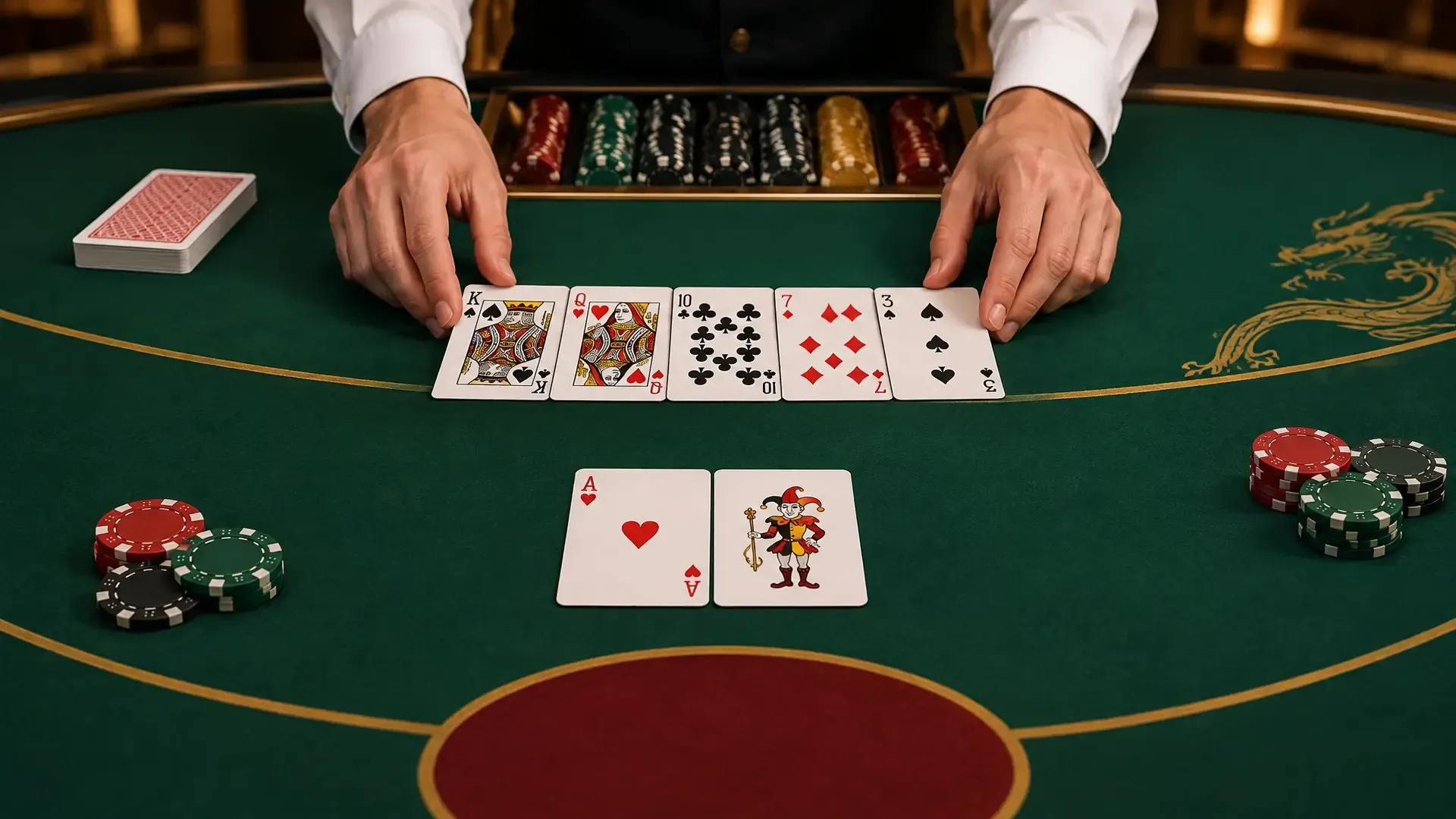
Pai Gow Poker is a seven-card game in which you divide your cards into two poker hands before comparing them with the banker's hands. The five-card hand is called the back or high hand, while the two-card hand is called the front or low hand. Understanding that division is the key to following the game.
This guide explains the basic deal, hand-setting rule, joker treatment, comparisons and push outcomes. Rules for jokers, ties, commissions and the banker's method can vary, so the specific table rules should always take priority.
How a Pai Gow Poker hand works
The sequence is straightforward. You receive seven cards, arrange them into one five-card hand and one two-card hand, and submit that arrangement. The banker sets a corresponding five-card back hand and two-card front hand. Your back hand is compared with the banker's back hand, and your front hand is compared with the banker's front hand.
If both of your hands beat the corresponding banker hands, you normally win. If both lose, you normally lose. If one hand wins and the other loses, the result is commonly a push, meaning the original wager is returned rather than treated as a win or loss. A tie in an individual comparison may be resolved according to the table's tie procedure, so do not assume every casino handles it identically.
For a broader introduction to the deal and table sequence, see how to play Pai Gow.
The essential hand-setting rule
Your five-card back hand must rank higher than your two-card front hand. This is the central rule of Pai Gow Poker. You cannot place a stronger poker combination in front and leave a weaker combination behind, even if that arrangement looks attractive in isolation.
The back hand is evaluated using ordinary five-card poker rankings, subject to any special rules printed for the table. Depending on the cards, it may contain a high card, pair, two pair, three of a kind, straight, flush, full house, four of a kind or straight flush. The front hand has exactly two cards, so its meaningful combinations are a pair or two unpaired cards compared by their highest card and then, where relevant, their lower card.
Before playing, review a reliable explanation of Pai Gow hand rankings if you are unsure how a straight, flush or pair compares with another five-card hand. Some ranking details, especially those involving unusual joker-made combinations, are ruleset-specific.
The table shows the structure rather than a universal best play. With the same seven cards, another legal division might be preferable under a particular strategy or house way. The important point is that the five-card hand remains stronger than the two-card hand.
How to set the front and back hands
Start by examining all seven cards, then identify the strongest five-card combinations available. Next, consider which two cards can be placed in front while keeping the back hand stronger. This is a balancing exercise: taking too many valuable cards for the front can weaken the back, while putting every strong card in the back can leave a very weak front.
There is no single arrangement that is automatically correct for every seven-card holding. The best setting depends on the complete hand, the applicable table rules and the objective of making both comparisons as competitive as possible. Beginner play should focus first on legality and clear comparison rather than trying to memorise an advanced chart.
Worked examples of legal and invalid settings
Example 1: a pair in the back. Suppose your seven cards are A♠, A♦, 8♣, 7♥, 5♠, 4♦ and 2♣. One simple legal setting is:
Here, the pair stays in the five-card back hand and the two-card front hand contains no pair. The arrangement is legal because a pair outranks two unpaired low cards. Whether it is the strongest practical setting would require comparing all possible divisions and the table's accepted procedures.
Example 2: an apparently strong but invalid setting. Consider 10♠, 10♦, 7♣, 7♥, A♣, 4♦ and 2♠. Putting 10♠ 10♦ in the front creates a pair, while leaving 7♣ 7♥ A♣ 4♦ 2♠ in the back also creates a pair. That arrangement may look balanced, but it is not automatically legal: the five-card pair with sevens must outrank the two-card pair of tens, and it does not. The stronger pair cannot be placed in front of a weaker pair in the back.
A legal alternative is to place the tens in the back and use two other cards in front, provided the resulting five-card hand still ranks above the front hand. This example illustrates why each hand must be compared with the other before the setting is submitted.
How the joker works
Pai Gow Poker commonly uses one joker as a limited wild card, not as a completely unrestricted card. At many tables, the joker acts as an ace unless it can complete a straight or flush. However, that is a common framework rather than a rule to assume everywhere.
The table may define how the joker works in a particular combination, how it is ranked in the front hand and how it affects unusual five-card hands. Read the posted rules or ask for clarification before setting a hand containing the joker. Do not treat it as any card you want without checking the exact rule.
Banker setting and the house way
The banker must also divide seven cards into a five-card back hand and a two-card front hand. When the house is setting the banker hand, it generally follows a prescribed procedure known as the house way. The house way is not necessarily identical at every casino or table; it can vary according to the published rules.
If you are banking yourself or playing under a player-setting procedure, the relevant setting method may be different. The practical lesson is to establish who sets the hand, which house-way guide applies and how an unclear arrangement is resolved before play begins. Never assume a chart seen elsewhere is universal.
Winning, losing and pushing
After both hands are set, compare like with like: back against back and front against front. Winning both comparisons produces the usual win outcome. Losing both produces the usual loss outcome. Winning one and losing one commonly produces a push, even though you have won one of the two comparisons.
A push is not the same as a win. It usually means the stake is returned, but the exact treatment can depend on the table's tie and banker rules. Some games also apply a commission to wins or give the banker a specified advantage when a hand ties. Check the published rules for those details rather than relying on a general Pai Gow explanation. A review of Pai Gow odds and commission can provide useful background, but it does not replace the rules for the table you are considering.
Common beginner mistakes
New players often reverse the terminology and assume the front hand is the five-card hand. Remember: front means two cards, and back means five cards. Another frequent mistake is placing a strong pair or other combination in front without checking whether the remaining five cards outrank it.
It is also easy to misread the joker as fully wild, or to treat a one-win, one-loss result as a winning hand. Finally, players sometimes copy a house-way setting without confirming that the same procedure applies at their table. Slow down, separate the seven cards visibly and verify the ranking order before submitting the hand.
Final beginner checklist
Receive seven cards, make exactly one five-card back hand and one two-card front hand, and confirm that the back hand outranks the front hand. Then compare each hand with the banker's corresponding hand. Use the joker only according to the stated rule, and check how ties, commissions and the house way are handled.
18+ responsible gambling notice: Gambling involves financial risk and correct hand setting does not guarantee a profit. Set a personal limit before playing, never chase losses and stop if gambling is no longer enjoyable or controlled. Check the specific casino's rules, commission, joker treatment and house-way procedure before you play.