How the House Way Works in Pai Gow Poker: Dealer Hand-Setting Rules, Examples by Hand Type, and Why It Matters
How the House Way Works in Pai Gow Poker
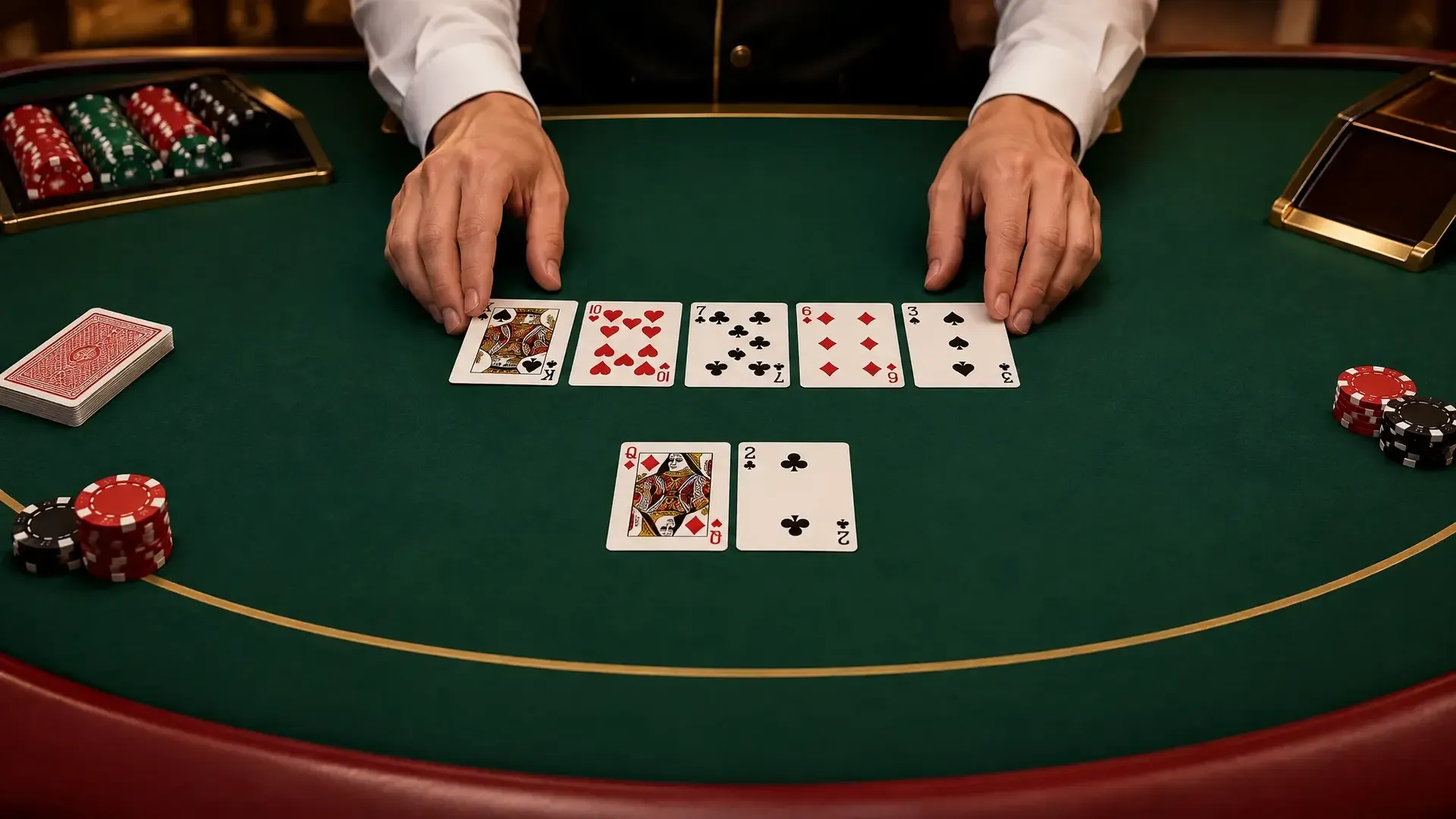
In Pai Gow Poker, the House Way is the preset procedure used to arrange the dealer’s seven cards into two legal hands. The dealer makes a five-card back hand, also called the high hand, and a two-card front hand, also called the low hand. Understanding that process makes dealer outcomes easier to follow, especially when the seven cards can be arranged in more than one reasonable way.
The House Way is not the same as a player’s personal strategy. A player may choose between several legal arrangements according to a strategy recommendation or personal preference, while the dealer follows the designated procedure for the table, casino, or game provider. Because procedures can differ, the examples below explain common principles rather than claiming to be a universal chart.
The basic seven-card structure
After the dealer receives seven cards, those cards must be divided into a five-card back hand and a two-card front hand. The back hand must outrank the front hand under Pai Gow Poker’s hand-ranking requirements. In practical terms, the dealer cannot place a stronger poker combination in front while leaving a weaker combination behind.
The decision normally begins by identifying the strongest available poker category: for example, a straight, flush, full house, four of a kind, or straight flush. The dealer then checks whether that combination can remain in the back hand while the remaining two cards form a legal front hand. If the hand can be divided in more than one legal way, the applicable House Way rule determines whether cards are kept together, separated, or assigned according to a stated priority.
This is why the House Way is best understood as a decision order rather than one universal trick. A general chart may list a category and an instruction such as “keep,” “split,” or “use the highest two cards,” but the instruction only has meaning when read with that venue’s definitions and exceptions.
Common House Way examples
No made combination
Suppose the seven cards are A♠, K♦, 9♣, 7♥, 4♠, 3♦, and 2♣, with no pair, straight, or flush. A straightforward arrangement is [A♠ K♦ 9♣ 7♥ 4♠] / [3♦ 2♣]. The five highest cards form the back hand and the two lowest cards form the front hand. A venue’s detailed procedure may describe this as playing the highest available back hand and the highest legal front cards, but the exact wording should be checked against the published rules.
A single pair
With 8♠, 8♦, A♣, K♥, 7♣, Q♠, and 3♦, one common arrangement is [8♠ 8♦ A♣ K♥ 7♣] / [Q♠ 3♦]. The pair stays in the back hand, while the two remaining highest cards make the front hand. This gives the dealer a made pair behind without putting a stronger front hand above it.
Single-pair rules are usually among the simpler entries on a House Way chart, but even here the exact priority may vary. A rule might preserve the pair in the back, or it might describe how unusually high side cards should be handled. The printed or online rules for the particular game control.
Two pairs
Consider 10♠, 10♦, 4♣, 4♥, A♠, K♦, and 7♣. One legal split is [10♠ 10♦ A♠ K♦ 7♣] / [4♣ 4♥]. The higher pair remains in the back hand and the lower pair becomes the front hand. This is a useful example because a two-pair hand does not automatically mean that both pairs stay together.
Many House Way systems have special two-pair instructions. Depending on the values of the pairs and the side cards, a venue may keep both pairs in the back, split them, or use another prescribed arrangement. A decision that looks stronger to a player is not necessarily the dealer’s designated House Way choice.
Three of a kind and a full house
For three of a kind, suppose the cards are 9♠, 9♦, 9♣, A♥, K♠, Q♦, and 2♥. A representative arrangement is [9♠ 9♦ 9♣ A♥ K♠] / [Q♦ 2♥]. The trips stay in the back hand, with the best available side cards completing that hand and the remaining cards forming the front.
Now consider a full house: 7♠, 7♦, 7♣, 4♥, 4♠, A♦, and K♣. A common preservation example is [7♠ 7♦ 7♣ 4♥ 4♠] / [A♦ K♣]. Keeping the full house intact produces a very strong back hand and leaves a legal two-card front hand. However, rules for full houses and other strong made hands should not be assumed to be identical at every venue.
Four of a kind
Four of a kind illustrates why House Way variations matter. With 8♠, 8♦, 8♣, 8♥, A♠, K♦, and Q♣, one possible arrangement is [8♠ 8♦ 8♣ 8♥ A♠] / [K♦ Q♣], preserving the quads in the back hand. Another procedure may split the four of a kind, for example [8♠ 8♦ 8♣ A♠ K♦] / [8♥ Q♣], if its rules call for a pair in front under particular conditions.
Neither example should be treated as the universal dealer rule. Whether a four of a kind is kept together or divided can depend on the rank of the quads, the side cards, and the game’s published House Way.
Straights, flushes, and straight flushes
When the seven cards contain a straight, the dealer commonly tries to preserve that five-card combination in the back hand if the remaining cards can form a legal front. For example, 5♠, 6♦, 7♣, 8♥, 9♠, A♦, and K♣ can be arranged as [5♠ 6♦ 7♣ 8♥ 9♠] / [A♦ K♣].
The same basic idea can apply to a flush. If five cards of one suit make the strongest available flush, those cards may stay together in the back, with the two remaining cards in front. A straight flush is an even stronger category, and a general House Way may preserve it, but a specific rule set can contain exceptions about splitting or using particular cards. The category alone does not tell you every dealer decision.
Why a stronger-looking front hand can be illegal
Imagine seven cards that include a pair of queens, a pair of fives, and three useful side cards. A player might be tempted to put the queens in the two-card front hand because that looks powerful. But if the five-card back hand contains only the lower pair and unrelated cards, the front hand would outrank the back hand. That arrangement is not legal.
The correct split must leave the back hand stronger than the front hand. This is the central check behind every House Way decision. A hand can look attractive when viewed one section at a time and still fail when the two sections are compared with each other.
How to read a House Way chart
A chart normally works from the highest available category downward. Find the row for the hand type, then check whether the entry tells the dealer to preserve the combination, split it, or use particular remaining cards. Words such as “high pair,” “low pair,” “split,” and “keep together” need to be read exactly as the venue defines them. If two arrangements are tied under the chart, an exception or tie-breaking instruction may decide between them.
For a broader introduction before studying these arrangements, readers can review how to play Pai Gow. Those basic rules provide the context for comparing a five-card back hand with a two-card front hand. A separate house way and strategy discussion can then help distinguish the dealer’s fixed procedure from choices available to players.
Why players should understand the House Way
Knowing the House Way makes dealer outcomes less mysterious. It lets players see why the dealer did not necessarily choose the arrangement that appears strongest at first glance, and it provides a fair basis for comparing the dealer’s fixed method with the player’s own hand-setting decision.
It is also important when considering the game mathematically. The dealer’s arrangement affects whether hands win, lose, or push, while commission and other game conditions affect the overall calculation. Readers comparing those factors can explore Pai Gow odds and commission, but no House Way rule guarantees a win, a push, or a lower house edge.
Final takeaway
The House Way is the designated method for turning seven dealer cards into a legal five-card back hand and two-card front hand. Its broad priorities are understandable—identify the best available category, preserve or divide it according to the rule, and ensure the back hand outranks the front—but the exact treatment of pairs, two pairs, full houses, four of a kind, and other combinations varies. Always verify the controlling version in the specific casino’s table-game rules or the game provider’s documentation before treating a chart as authoritative.
Gambling is for adults aged 18+ only (or older where local law requires). Play responsibly: set a budget and time limit in advance, treat gambling as entertainment rather than a way to make money, and contact a local support organisation if gambling stops being fun.